


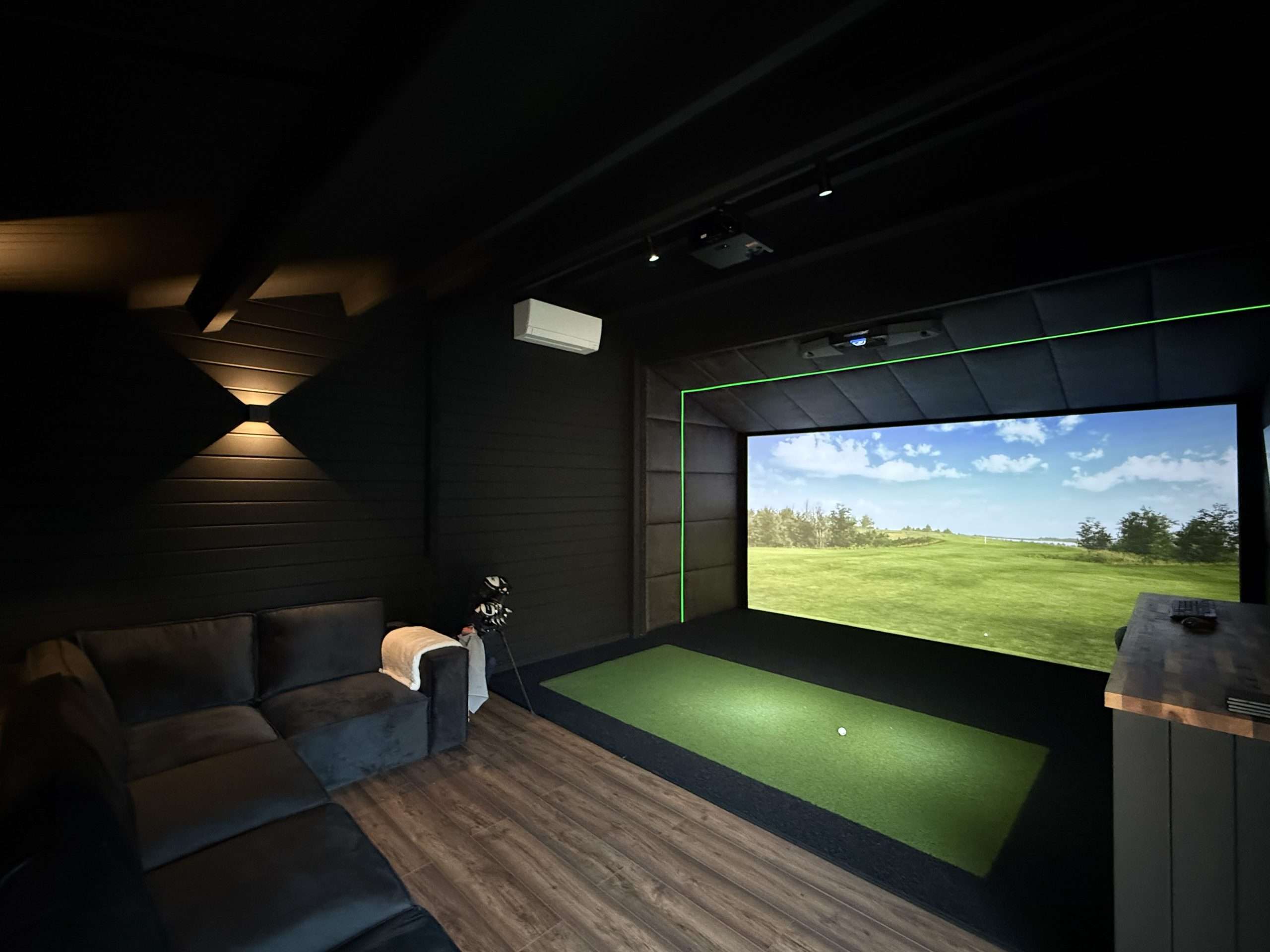
You can play golf at home in three ways. A putting mat or a chipping net works in almost any room and costs very little. A net with a launch monitor lets you hit full shots and see the numbers. A golf simulator room goes furthest, because you can play real courses, practise every club and compete with other golfers without leaving the house.
Which one suits you depends on your space, your budget and how often you will really use it. A full swing with a driver needs at least 2.7m of clear height, so the ceiling usually decides it before anything else. Below we go through each option, what it needs and what it costs, using what we have learned from more than 1,000 installations across the UK.
Putting and chipping indoors
The cheapest way to keep your golf going at home is the short game. A putting mat on the carpet, a few balls and a cup are enough to work on pace and start line. It needs no extra height, so a hallway or a spare room will do.
When courses closed in the spring of 2020, The R&A ran its #GolfAtHome campaign. It asked golfers to practise at home or in the garden, in a safe and responsible way. The drills from that time still work. European Tour coach Hugh Marr’s ladder drill is a good one for chipping. Hit a ball about five yards, then try to land each new ball just past the last one, and count how many you can string together.
The limits are obvious. You cannot hit a full shot, and a mat on a carpet never rolls like a green. If the short game is where you lose most shots, a proper putting green in the garden or beside a simulator is worth a look. It needs far less height than a full swing.
Hitting full shots into a net
A net, a hitting mat and a launch monitor let you swing every club and see ball speed, launch and carry for each shot. It fits in a garage or a garden building.
The drawbacks show after a few weeks. A cold garage in January gets used less. A thin, hard mat jars the wrists and flatters poor strikes. Without a screen and software you are hitting balls into a net rather than playing holes, and that gets dull quickly.
If you go this way, spend on the mat first and keep the net well clear of walls and windows. Camera and radar launch monitors need different amounts of room behind and in front of the ball, so measure before you choose one.
A golf simulator room
A simulator adds a projector, an impact screen and software to the launch monitor. You hit a real ball into the screen and watch it fly down a real course. You can play a full round, practise one club on the range or work on the shots that cost you most. The software you run decides which courses and practice modes you get.
This is the option that makes golf at home feel like golf. It is also the one that depends most on the room. A mid-range launch monitor in a room with enough height gets used more than a premium one in a room where you have to shorten your swing. Whether a home golf simulator is worth it comes down to how often you already practise, more than how much you spend.
How much space golf at home needs
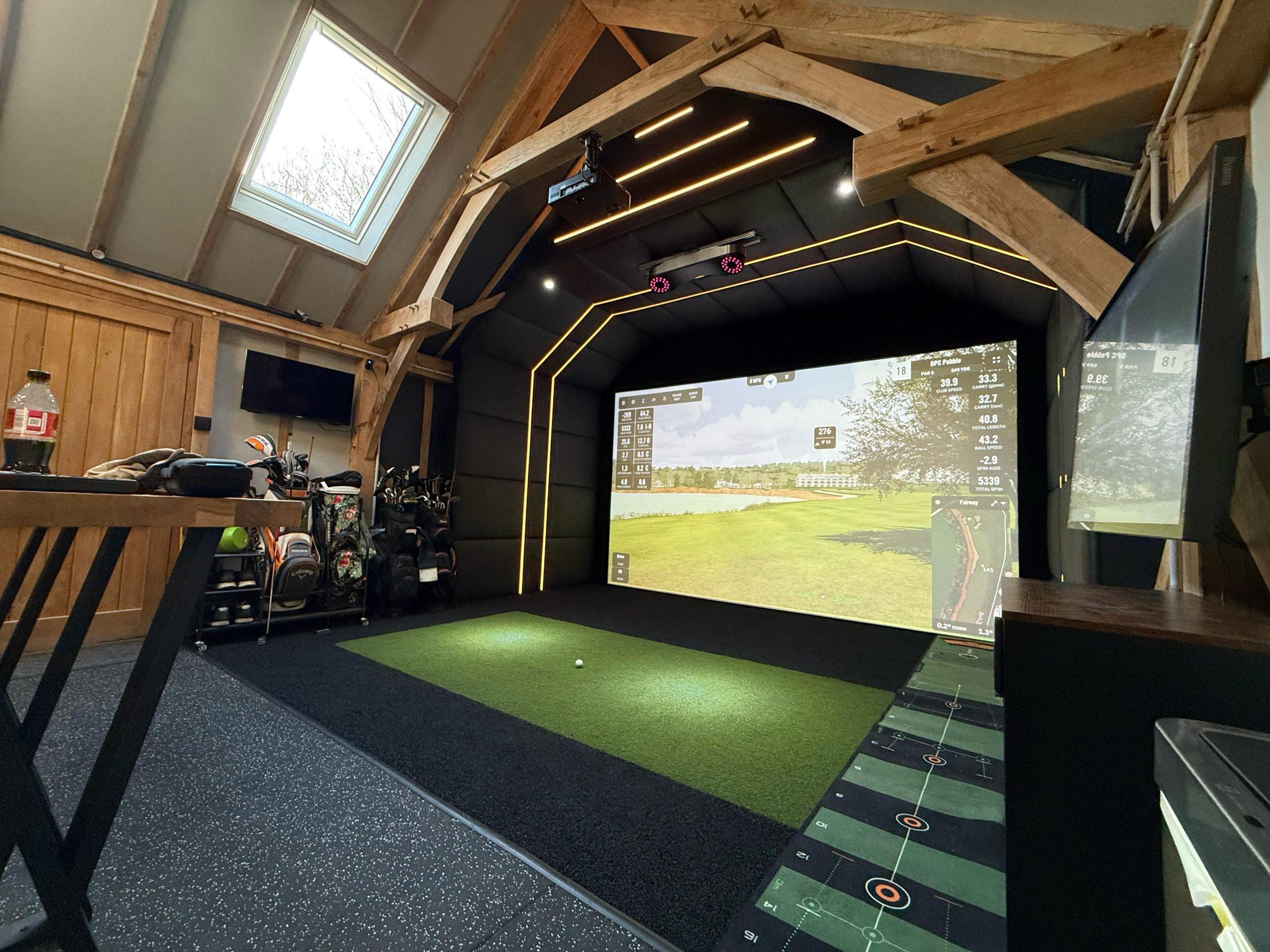
Height is the number to check first. You need at least 2.7m of clear height to swing a driver, and 2.9m is more comfortable. Measure from where you will stand to the lowest thing above you, whether that is a beam, a light or the projector.
For the floor, our minimum is 3m wide by 4.5m deep. The size we find most comfortable is about 3.5m by 5m with a 2.9m ceiling. TrackMan’s room size recommendations ask for more, with a 3m ceiling, a width of 4.6m and 3m between the ball and the screen for its iO unit.
Real rooms show the range. Our Hertfordshire room is 4m by 4m with a 2.8m ceiling, close to the minimum. The log cabins we fitted out in Bury and Leeds are 4.5m by 6.6m, which leaves space for a sofa beside the hitting area. In an East Sussex barn, a 4.5m by 6m room fits a putting strip next to the mat.
Garage, log cabin or garden room
Most of the golf rooms we build sit in one of four places.
- A garage conversion, if the garage has the height and you can give up the space.
- A log cabin in the garden, built as a shell and then fitted out for golf.
- A bespoke garden room, designed around the size and height you need.
- A room you already have, such as a barn or a large outbuilding, with a golf simulator fit-out.
In our experience, log cabin builds work better than garage conversions for tight timelines, because the cabin is made off site while the groundwork goes in. A full log cabin build runs two to three weeks from groundwork to handover. A garage or garden room fit-out usually takes three to five working days once the space is ready.
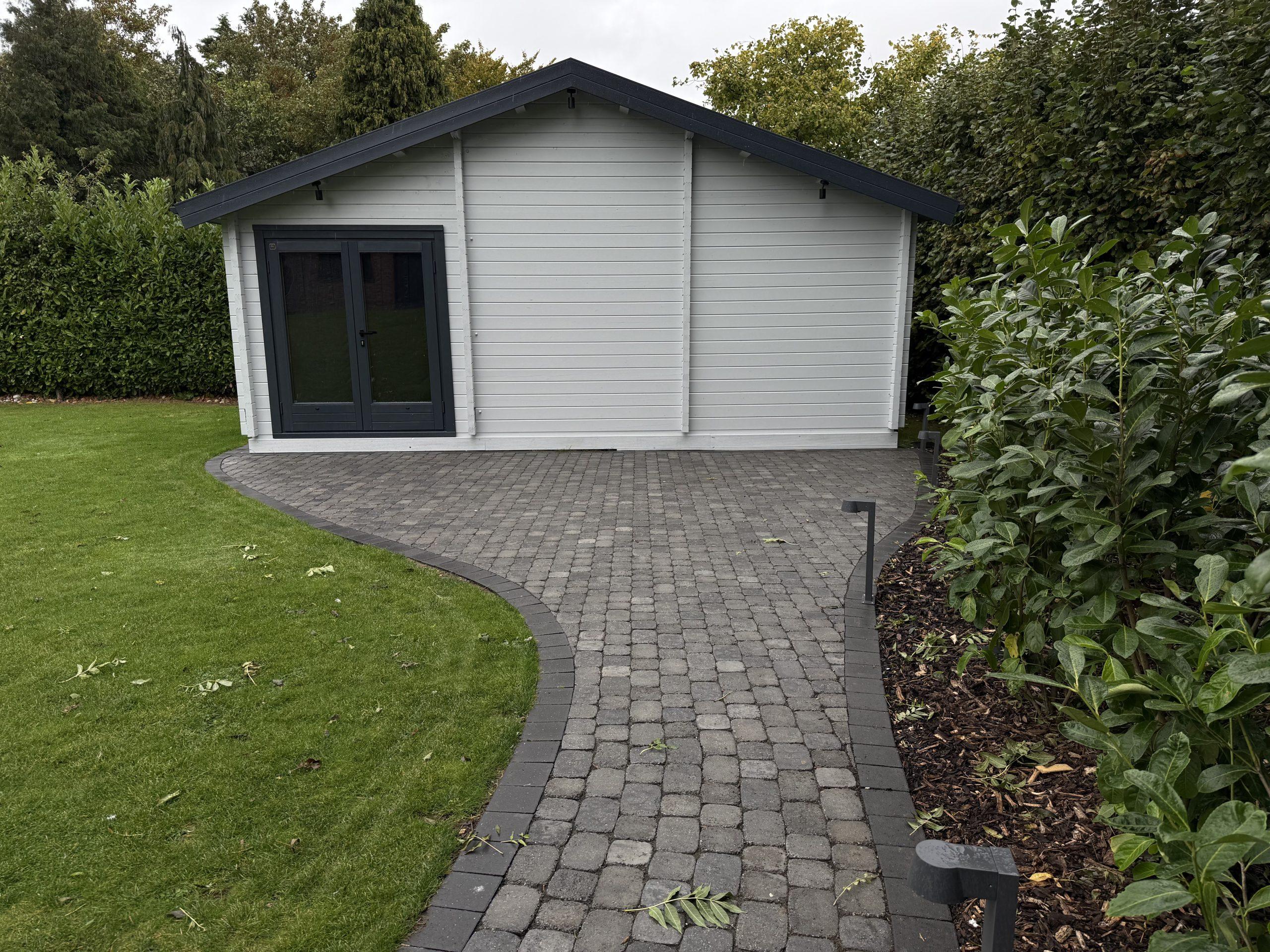
A building in the garden also needs a thought about planning. Under permitted development in England, an outbuilding within 2m of a boundary can be no more than 2.5m high. That is too low for a full swing inside. Further from the boundary, the Planning Portal’s outbuilding rules allow eaves of up to 2.5m and up to 4m overall with a dual-pitched roof. Your local planning authority has the final word, and Wales and Scotland set their own rules. Planning often decides where a golf simulator garden room can go on a plot, so check it before you settle on a spot.
What golf at home costs
A basic enclosure kit with an entry-level launch monitor starts at around £2,000. A complete room is a different scale of project. From our projects this year, a garage fit-out with a solid mid-range setup costs £18,000 to £55,000. A purpose-built log cabin with a full fit-out starts at around £30,000, and a higher-specification garden room runs from £50,000 to £150,000.
Most of the difference in what a golf simulator costs is the room, not the technology. Insulation, heating, lighting and electrics decide whether you use it in winter. Software subscriptions are a yearly cost that buyers often forget.
Match the kit to your game rather than to the biggest budget. Clayton came to us with TrackMan in mind. In his Trustpilot review he wrote that Matt “explained that for my level (28 handicap) I really didn’t need it and recommended a setup better suited to me.”
Making golf at home a room you actually use
The rooms that get used most are warm, close to the house and quick to start. A room that is cold in November tends to sit idle until March. We have found infrared panel heaters work well for heating a golf simulator room through a UK winter. They warm the space quickly without pushing air across the hitting area.
Keep the walk short and the start-up simple. If the room is a few steps from the back door and ready to play, a short session after work becomes realistic. Anthony Pink put it simply in his review. He called his setup “perfect for practising our game whatever the weather.”
Playing against other golfers from home
Golf at home does not have to mean playing alone. We designed Golf Sim Leagues, a weekly online competition for home simulator owners. You play the week’s course in your own room on GS Pro and submit your score. Each flight has up to 100 players, with prizes every week. Handicaps are reviewed every week, so the contest stays fair. You can sign up on the Golf Sim Leagues website.
Conclusion
Golf at home can be a putting mat in the hallway or a full simulator room in the garden. Start with your space. Measure the height first, then the width and depth, and be honest about how often you will use it. If you want a room where you can play every club all year, Golf Sim Rooms can survey your space and tell you what will fit. Book a free consultation to get started, or request a brochure to see the rooms we build.